Feathers Near the Angel's Trumpet: Why Avian Entheogen Exposure Is Veterinary Toxicology's Quietest Blind Spot
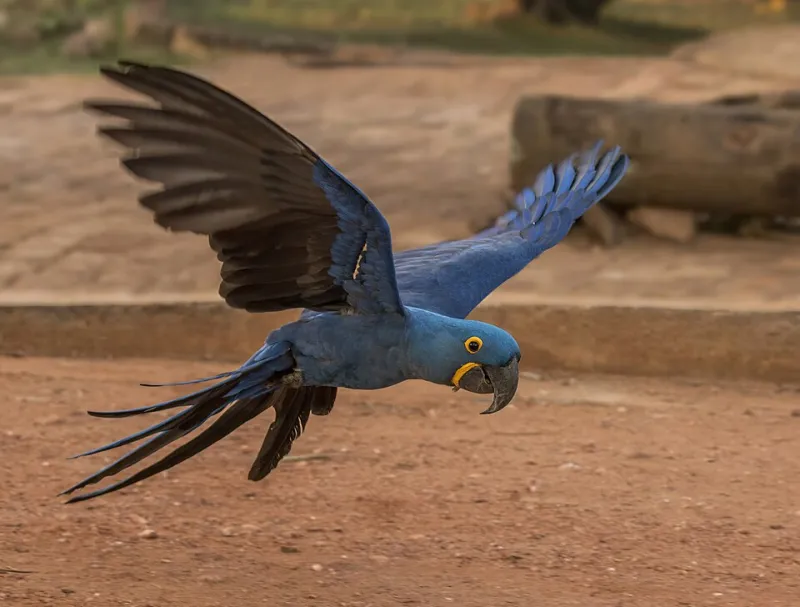
Photo: Charles J. Sharp, CC BY-SA 4.0, via Wikimedia Commons
The Collection That Grows Its Own Risk
Walk through enough private aviaries, conservatory bird rooms, and zoo walkthrough exhibits in the United States and a pattern emerges: the plants chosen to enrich a flight space are frequently the same genera that dominate entheogenic botany. Brugmansia cuttings overwinter in greenhouses attached to finch flights. Mimosa tenuiflora root bark sits in the same supply chains that serve ethnobotanical hobbyists. Passiflora vines climb the mesh of outdoor psittacine enclosures across the Sun Belt.
Whether any of this constitutes a meaningful exposure risk is, at present, a question nobody in American avian medicine can answer with data. That absence is not an accident. It is the product of several compounding gaps — diagnostic, economic, and cultural — that have left birds almost entirely outside the conversation about psychoactive plant toxicology in animals.
A Diagnostic Funnel That Loses Birds First
The mammalian side of this field, thin as it is, at least benefits from infrastructure. Companion mammal exposures can be flagged by poison control call centers, worked up with mammal-calibrated reference intervals, and occasionally confirmed on liquid chromatography or gas chromatography–mass spectrometry panels developed for human toxicology.
Avian patients enjoy none of that scaffolding. Reference ranges for tropane alkaloids, indoleamines, or beta-carboline exposure in psittacines simply do not exist in published form. Avian blood volumes constrain how much sample a clinician can spare for send-out testing that insurance rarely covers and laboratories rarely offer. And the classic presenting complaint for a bird that chewed something it shouldn't have — sudden lethargy, regurgitation, feather-destructive behavior, unexplained death — overlaps almost perfectly with a dozen more familiar avian syndromes.
"When a macaw dies overnight after an unknown exposure, the necropsy differential is already a page long," one board-certified avian veterinarian told VetEntheogenic, speaking on condition of anonymity because the case involved a breeder client. "Nobody is running an alkaloid screen on that bird. It isn't on the checklist."
What Practitioners Suspect
Informal interviews with avian practitioners across four states surfaced a handful of anecdotes that stop short of evidence: a cockatoo with persistent neurological signs after reportedly stripping a Brugmansia seed pod; a flighted conure flock with transient ataxia following access to a greenhouse overwintering Datura; a zoo walkthrough exhibit where keepers quietly removed a passionflower vine after birds began obsessively working the seed pods.
None of these cases were published. None could be. Without analytical confirmation, an anecdote about a parrot and an angel's trumpet is indistinguishable from an owner's post-hoc narrative — precisely the kind of unverified exposure report the field's adverse event infrastructure was already failing to capture for mammals.
Why Foraging Intelligence Cuts Both Ways
The welfare argument for studying this gap rests on a paradox. Parrots are celebrated for cognitive capacities — extractive foraging, neophilia, social learning from flockmates — that make them among the most behaviorally sophisticated animals humans keep. Those same traits mean a captive parrot is arguably more likely than a dog to deliberately deconstruct a seed pod, learn pod-opening technique from a cage mate, and return to a novel food source repeatedly.
In other words, the species most capable of seeking out psychoactive plant material in captivity is the species about which we know the least regarding what happens next. That asymmetry should trouble welfare scientists regardless of whether one cares about entheogens as such. A bird that repeatedly self-exposes to tropane alkaloids is a welfare problem whether or not the exposure produces anything resembling an altered state.
A Modest Research Agenda
Closing the gap does not require administering psychedelics to parrots. It requires:
- Retrospective necropsy review. Teaching hospital archives hold decades of avian necropsies from collections with documented psychoactive flora. Re-screening tissue banks for tropane and indole alkaloids is feasible and noninvasive.
- Analytical method development. Avian-adapted LC-MS confirmation panels would serve general avian toxicology even if entheogen-specific findings never materialize.
- Exposure inventory surveys. Simple audits of which psychoactive species cohabit with US aviaries — private, commercial, and institutional — would establish a denominator that currently does not exist.
The Cost of Not Looking
There is an uncomfortable precedent here. Livestock veterinarians spent a century mapping serotonin-active plant toxicology in the feed bunk before human psychedelic science caught up to the receptor pharmacology. Birds, arguably the most pharmacologically idiosyncratic vertebrates humans commonly keep, were never part of that mapping effort.
The result is a class of animals that share living space with some of the most pharmacologically potent plants in cultivation, possess the cognitive machinery to access them deliberately, and remain invisible to every surveillance system that might notice. Until someone funds the unglamorous work of screening old tissue and auditing collections, the aviary question will stay exactly where it is today: unanswered, unasked, and unrecorded.