Small Minds, Big Questions: Rethinking Invertebrate Welfare When Bees Visit the Passionflower
A Nectar Source Like Any Other — Or Is It?
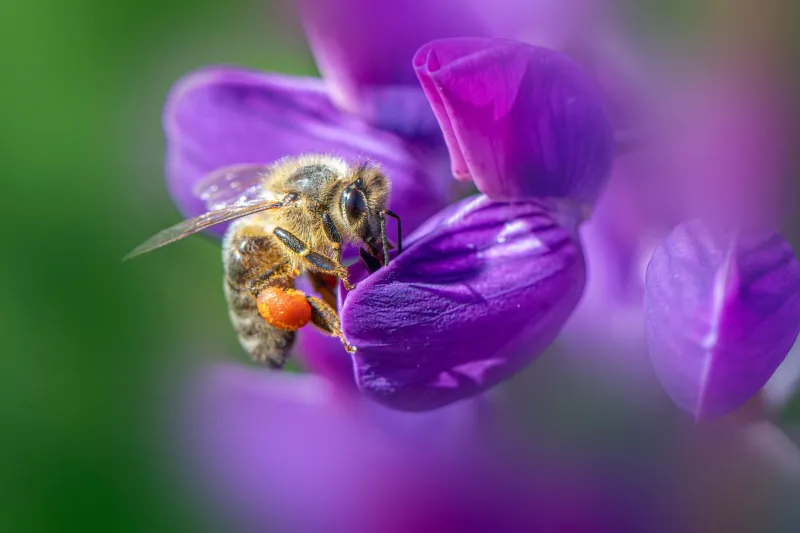
On a July morning in a California research garden, honeybees work a stand of Ipomoea tricolor with the methodical efficiency they bring to any flower. What distinguishes this forage is chemistry: morning glories are among the world's most reliable natural sources of ergine (LSA) and related ergoline alkaloids. The bees are, in a technical sense, dosing themselves — not by intent, but by ecology.
Nobody in mainstream entomology or animal welfare has treated this as a problem. But the question of whether it should register — whether insects foraging on serotonergic and ergoline-bearing plants have experiences that matter — has moved from a philosophical curiosity to something approaching a live policy issue in the United States.
The Neurochemistry of a Very Small Brain
The insect nervous system is often caricatured as a hardwired reflex machine. That caricature has not aged well. Honeybees possess roughly one million neurons — few by mammalian standards, but enough to support landmark learning, state-dependent behavior, and something that looks, at least functionally, like an emotional valence system.
Critically for this question, insects run on many of the same neurochemical substrates that psychedelic research cares about. Octopamine and dopamine play roles analogous in some respects to vertebrate catecholamines, and serotonin is present and active in insect nervous systems, modulating feeding, aggression, and circadian behavior. Plant alkaloids that target serotonergic and dopaminergic pathways in mammals do not simply pass through an insect like inert ballast.
Dr. Elena Marsh, a comparative neuroethologist we interviewed for this piece (who studies pollinator cognition at a Pacific Northwest university), puts it carefully: "We can document that alkaloid exposure changes bee behavior — reduced foraging persistence, altered odor learning. What we cannot yet do is say what, if anything, that change feels like from the inside. The honest answer is that the internal question is currently unanswerable."
Caterpillars complicate the picture further. Many lepidopteran larvae feed preferentially on plants rich in serotonin and related amines, including various Passiflora species. Whether larval sequestration of plant amines constitutes exposure in any morally meaningful sense — or just ordinary herbivory — depends entirely on framework you bring to the question.
The Sentience Question Arrives in American Ethics Discourse
For most of the twentieth century, US institutional animal care obligations stopped at vertebrates. The Animal Welfare Act, the IACUC system, and state anti-cruelty statutes all draw the line at the backbone.
That line is under review. The 2021 declaration signed by a multidisciplinary group of researchers arguing for a precautionary approach to insect sentience received substantial attention in the American scientific press. Several prominent US funding agencies and universities have begun asking grantees to justify invertebrate work with more than a formality. Some institutions now require anesthesia standards for cephalopods and, increasingly, for decapod crustaceans — species once categorically excluded.
Entheogenic botany adds a distinctive wrinkle. The traditional welfare question was whether an intervention causes suffering. The entheogenic question is subtler: whether a naturally occurring pharmacological exposure alters the subjective state of an organism whose capacity for subjective state is itself contested. There is no established methodology for answering it, and no consensus that one is even possible.
Three Frameworks, Three Uncomfortable Answers
We asked ethicists and entomologists to sketch what it would mean if the strongest versions of each major framework turned out to be correct.
The precautionary view. If uncertainty about insect sentience warrants moral caution, then routine ecological exposures — bees on ergoline nectar, caterpillars on serotonin-rich foliage — become a standing, unresolvable welfare question. This position, taken seriously, would demand exposure monitoring for managed pollinators near psychoactive flora and possibly reconsideration of ornamental planting guidelines. Nobody we spoke with thinks such regulation is imminent; several noted the logistical absurdity of auditing nectar chemistry at scale.
The capacity view. If moral status tracks demonstrated cognitive capacity, the answer depends on empirical work that barely exists. Behavioral evidence of optimistic-versus-pessimistic judgment biases in bees — studies conducted at institutions including Newcastle University and, in preliminary forms, at US labs — suggests state-dependent appraisal. But appraisal is not experience, and the gap between the two is where most US ethicists currently plant their flag.
The relational view. If moral consideration flows from relationships and roles, then a wild caterpillar on wild passionflower falls outside the moral community entirely, while a laboratory colony exposed to alkaloids under a grant falls inside it. This framework, whatever its philosophical merits, produces the jarring result that identical chemistry carries different moral weight depending on who is holding the pipette.
What This Means for Veterinary and Comparative Science
For the veterinary and entheogenic research communities, the practical stakes are narrower but real. Comparative psychopharmacology increasingly uses insects — Drosophila serotonergic pharmacology is foundational to receptor work that informs mammalian psychedelic research. If US IACUC-style oversight eventually extends downward to insects, protocols involving psychoactive alkaloids will be among the first scrutinized, because the compounds are already philosophically loaded.
There is also a communication problem. Wildlife rehabilitators, apiculture extension agents, and toxicologists field questions from the public about "drugged bees" with no evidence base to draw on. The absence of data is not the same as the absence of interest.
Living With an Uncomfortable Maybe
The most defensible position, several of our sources agreed, is neither dismissal nor panic. The entomological evidence does not establish that insects on serotonergic plants are suffering. It also does not establish that they are not. What it establishes is that a category of exposure we have never morally inventoried is happening constantly, at enormous scale, across every American landscape where entheogenic flora grows.
Whether that matters is, for now, a question each reader must answer with the framework they already hold. The science, meanwhile, has its work cut out for it — starting with the unglamorous task of documenting what these exposures actually do to insect behavior, physiology, and fitness before anyone decides what they mean.
The bees, indifferent to the debate, will keep visiting the morning glories either way.